Image of the Wolf CARDS multifunction device
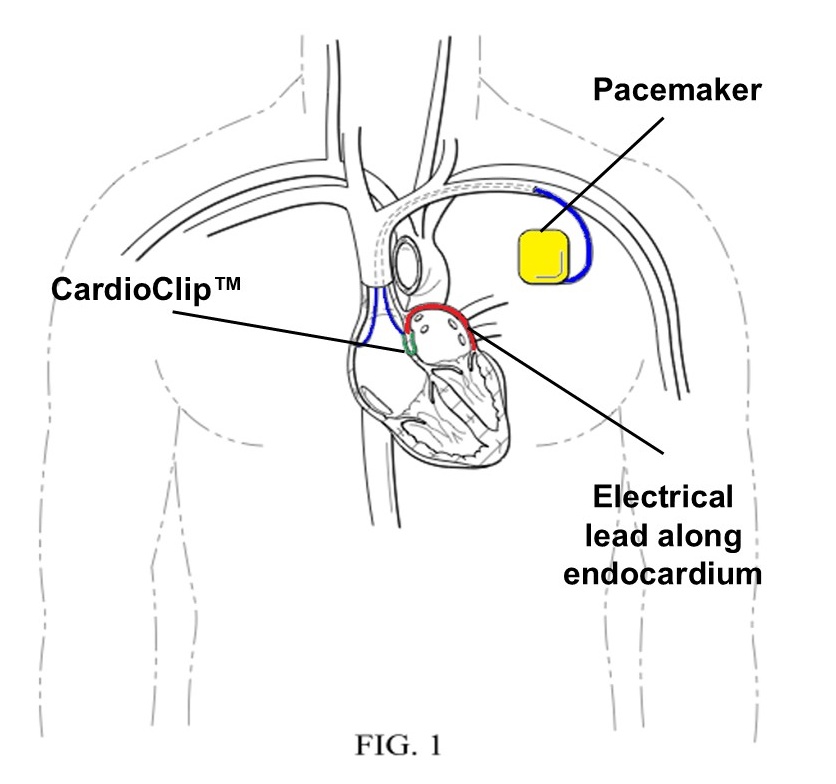
The WOLF CARDIOClip™ multifunction device with its innovative technology willl dramatically evolve the outpatient treatment of cardiac arrhythmias, allowing (1) patient-controlled cardioversion outside the hospital, with its innovative technology, (2) first-ever biatrial pacing for atrial synchrony, and (3) the mapping of atrial arrhythmias outside of the cath lab
The system includes a novel biatrial pacing lead which has several characteristics:
1. It provides patient-controlled ultra-low energy biatrial cardioversion, usually one Joule. For comparison, one joule is the energy needed to power a 1-watt LED light for one second, an amount of light almost not visible to the human eye. In comparison, an external cardioversion will use between 200 and 360 Joules, the energy required to lift 81 pounds to a height of 3.3 feet!
2. It allows true biatrial pacing (see "Why is biatrial pacing better" below). All atrial pacing until now, has been performed through combinations pacing the right atrium, the right ventricle, and the coronary sinus. The WOLF CARDIOClip™ multifunction device will be of great diagnostic value providing information on activation and maintenance of atrial fibrillation.
3. Until now, the mapping of atrial arrhythmias has been performed at a hospital or outpatient cath lab. For the first time ever, it will be possible to record and map atrial activity outside the cath lab (real world data). This real world information utilizing AI may allow us to pinpoint the initial activation of atrial arrhythmias in the natural environment.
The WOLF CARDIOClip™ multifunction device will notify the patient immediately on the initiation of atrial arrhythmias via a cell phone app (in many cases the patient is not aware of the presence of AFib until later). Delayed cardioversion is associated with progressive atrial electrical and structural remodeling, which can perpetuate arrhythmias and lower the likelihood of maintaining NSR. Early cardioversion (often defined as within 12-48 hours of symptom onset) has been correlated with higher immediate success rates and reduced electro-structural changes that favor arrhythmia recurrence
Why is biatrial pacing better?
The heart beat starts on the right atrium at a structure known as the sinoatrial node. From here the electrical impulse needs to get to the left atrium as fast as possible to have both atria contract at practically the same time. This is possible because the electrical impulse travels to the left atrium through a muscular ridge that connects both atria. This muscular ridge is known as "Bachmann's bundle". Bachmann's bundle was discovered in 1916 by J.G. Bachmann.
When Bachmann’s bundle is intact, left atrial activation is almost simultaneous with the right atrium. If it is damaged, it can cause varying degrees of interatrial block (IAB), and electrical conduction must proceed through other less effective pathways, resulting in an altered cardiac rhythm. Advanced IAB is strongly associated with atrial fibrillation, left atrial mechanical dysfunction, and increased risk of stroke even in sinus rhythm.
IAB can be caused by fibrosis, fatty infiltration, atrial dilation, aging, ischemia, and iatrogenic damage in prior cardiac surgery or ablation. All these preferentially affect the anterosuperior interatrial region, explaining the bundle’s vulnerability.
Historically, all pacemakers terminal wires have been implanted in the right atrium. but the potential dysfunction of Bachmann's bundle would require biatrial pacing, which is not used today, except for the WOLF CARDIOClip™ multifunction device .
1. Airaksinen KEJ. "How to optimize cardioversion of atrial fibrillation". J Clin Med. 2022;11(12):3372.
2. Cappato, R; Ezekowitz, M; Hohnloser, SH, et al”Predictors of sinus rhythm 6 weeks after cardioversion of atrial fibrillation: a pre-planned post hoc analysis of the X-VeRT trial”, EP Europace, 2021 23:10, 1539– 1547,
3. Arnar DO, Danielsen R. Factors predicting maintenance of sinus rhythm after direct current cardioversion of atrial fibrillation and flutter: a reanalysis with recently acquired data. Cardiology. 1996 May-Jun;87(3):181-8.
4. Rigamonti F, Shah DC. "Bachmann Bundle Block Occurring During Radiofrequency Ablation at the Inter-Atrial Septum" J Clin Med. 2012;15(9):263.
5. Zhang Y, Wu F, Gao Y, Wu N, Yang G, Li M, Zhou L, Xu D, Chen M. "Bachmann bundle impairment following linear ablation of left anterior wall: impact on left atrial function". Int J Cardiovasc Imaging. 2022 Jan;38(1):41-50.